Tell us about the job
Takes about a minute. No obligation.
The burner and ignition system on a Mineral County furnace cycle through a long working season before they ever get a rest. Homes in Mineral County, NV run heat about eight months a year, from October through May. By the time a unit shows a fault, the heat exchanger has already logged a full run of thermal stress, and the igniter has fired hundreds of times since its last inspection. A contractor diagnosing a repair here pulls those components before anything else, because that is where the accumulated load lands first.
Furnace repair in housing this old often stalls not at the diagnosis but at the parts order. Half the homes in Mineral County, Nevada were built in 1971 or earlier (2020-2024 ACS 5-year). A system that has been running in ductwork laid out for something else, in a house never rewired for it, is a system that the contractor has to read component by component once it is open. If a heat exchanger or a control board turns out to be a discontinued part, the job changes shape entirely, and the homeowner is making a different decision than they came in expecting.
The Parts of a Furnace a Contractor Checks First
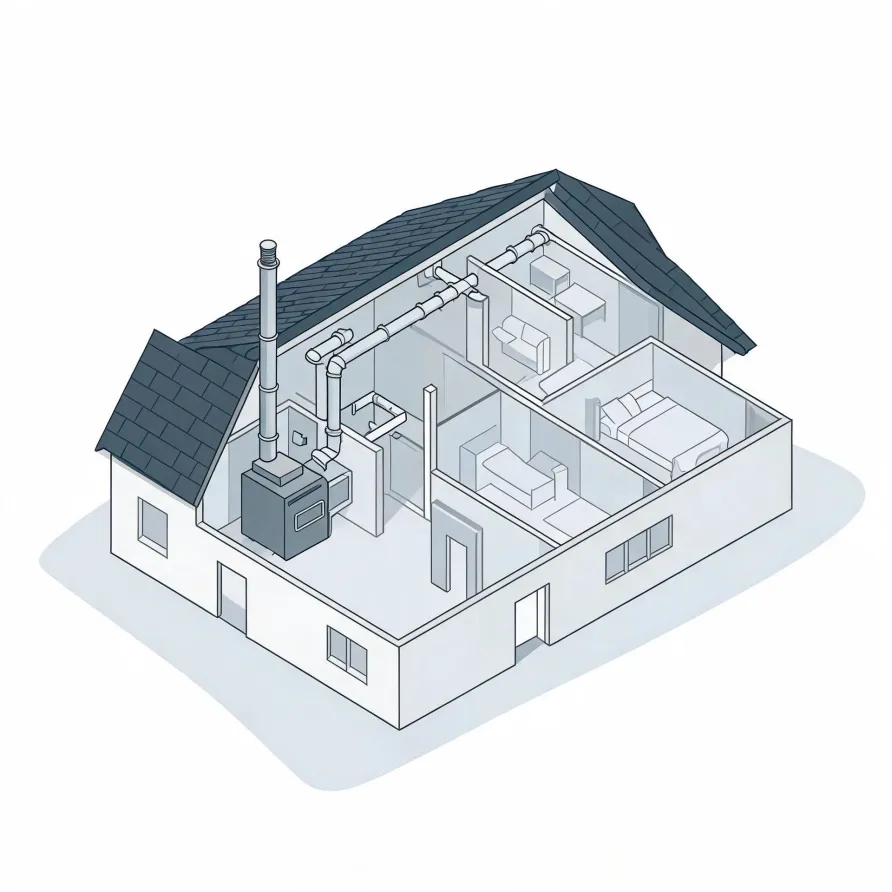
The furnace itself sits in the basement, utility closet, or garage and is the first thing a contractor opens up. Inside it, the heat exchanger is the piece that takes the most abuse and cracks when something goes wrong with combustion. The burners, which fire just below it, are checked when the furnace fails to ignite or produces uneven heat.
The blower motor sits at the base of the furnace cabinet and pushes conditioned air out through the house. Beside it, the control board reads signals from the thermostat and tells every other component when to act. When a furnace behaves erratically or shuts itself off, one of these two is often where the contractor starts.
The drawing shows a typical furnace layout, and a licensed contractor determines which components apply to your specific system and situation.
Get matched in Mineral CountyMineral County by the Numbers
82 severe weather events were recorded in Mineral County, Nevada between 2015 and 2024.
NOAA National Centers for Environmental Information, Storm Events Database, bulk CSV export, events 2015-01-01 through 2024-12-31.Half the homes in Mineral County, Nevada were built in 1971 or earlier (2020-2024 ACS 5-year).
U.S. Census Bureau, 2020-2024 American Community Survey 5-Year EstimatesMineral County, Nevada holds 2,281 housing units (2020-2024 ACS 5-year).
U.S. Census Bureau, 2020-2024 American Community Survey 5-Year EstimatesOwners occupy 72.5% of the occupied homes in Mineral County, Nevada (2020-2024 ACS 5-year).
U.S. Census Bureau, 2020-2024 American Community Survey 5-Year EstimatesCodes & Standards Governing Furnace Repair in Mineral County, Nevada5 sourced rules and standards
What HVAC Repair Looks Like in Mineral County
Non-weatherized gas furnaces manufactured on or after November 19, 2015 must reach 80.0 percent AFUE.
Non-weatherized oil-fired furnaces manufactured on or after November 19, 2015 must reach 83.0 percent AFUE.
Mobile home gas furnaces manufactured on or after November 19, 2015 must reach 80.0 percent AFUE.
Non-weatherized gas furnaces manufactured on or after December 18, 2028 must reach 95.0 percent AFUE, up from the 80.0 percent minimum that applies to units manufactured before that date.
Licensing Rules for HVAC Repair in Mineral County, Nevada
In Nevada refrigeration and air-conditioning work is specialty contracting, and a general building contractor may not perform it without holding the licence for that specialty.
Weather Stress on HVAC Equipment in Mineral County
Heating equipment works harder when outdoor conditions swing wide, and those swings accumulate as mechanical wear over time. How much strain a furnace carries is a local question, and the recorded weather history for this area is part of that answer.
82 severe weather events, 2015–2024. Source: NOAA National Centers for Environmental Information, Storm Events Database.