Tell us about the job
Takes about a minute. No obligation.
A contractor quoting a furnace repair in Lander County starts with the ignition system and the heat exchanger, because those are the components that cycle every time the burner fires. Homes in Lander County, NV run heat about nine months a year, from September through May. Across that kind of run, the igniter degrades, the heat exchanger accumulates thermal stress at its welds, and the burner ports collect residue that chokes combustion. A furnace that was undersized at install shows cracks and fatigue sooner, because it runs longer per cycle to hit setpoint. Wear on the control board and the blower motor follows the same logic. The idle months between June and August do little to reverse what the active months put in.
Furnace systems in stock this old have accumulated service histories that shape what a contractor finds once the unit is open: heat exchangers that have cycled through decades of cold desert nights, control boards on platforms that have since changed, and burner assemblies that may take parts a distributor has to source rather than pull from a shelf. Half the homes in Lander County, Nevada were built in 1986 or earlier (2020-2024 ACS 5-year). That gap between when these houses were built and what is running in them now means a repair quote cannot be written from the outside of the cabinet. What the opened furnace actually contains, and whether the components it needs are still in production, is what determines the scope and the cost.
The Parts of a Furnace a Contractor Checks First
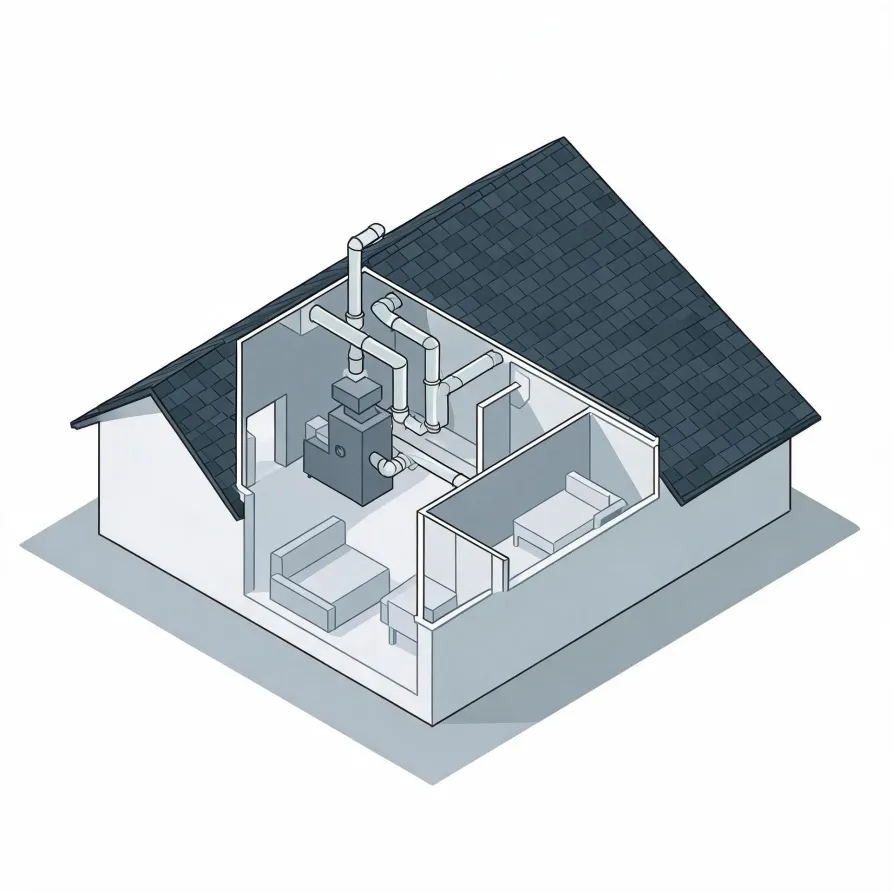
The heat exchanger sits at the heart of the furnace cabinet and is where combustion gases warm the air that moves into your home. When it cracks or warps, the furnace often shuts down on safety lockout or produces uneven heat. The burner assembly, just below it, is where fuel ignites, and a weak or dirty burner shows up as hard starting, short cycling, or a flame that lifts and flickers.
The blower motor and its fan wheel sit in the lower section of the cabinet and push conditioned air out through the supply side. The control board runs the sequence of operations for the whole unit, and a contractor will read its fault codes early in a diagnostic visit. The flue pipe exits the cabinet at the top or rear and vents combustion gases outside, where blockages or corrosion can trigger safety switches that shut the furnace down.
The drawing shows a general layout of these components, and a licensed contractor determines exactly what applies to the furnace in your house.
Get matched in Lander CountyLander County by the Numbers
186 severe weather events were recorded in Lander County, Nevada between 2015 and 2024.
NOAA National Centers for Environmental Information, Storm Events Database, bulk CSV export, events 2015-01-01 through 2024-12-31.Half the homes in Lander County, Nevada were built in 1986 or earlier (2020-2024 ACS 5-year).
U.S. Census Bureau, 2020-2024 American Community Survey 5-Year EstimatesLander County, Nevada holds 2,739 housing units (2020-2024 ACS 5-year).
U.S. Census Bureau, 2020-2024 American Community Survey 5-Year EstimatesOwners occupy 77.4% of the occupied homes in Lander County, Nevada (2020-2024 ACS 5-year).
U.S. Census Bureau, 2020-2024 American Community Survey 5-Year EstimatesCodes & Standards Governing Furnace Repair in Lander County, Nevada5 sourced rules and standards
What happens when the contractor arrives
Non-weatherized gas furnaces manufactured on or after November 19, 2015 must reach 80.0 percent AFUE.
Non-weatherized oil-fired furnaces manufactured on or after November 19, 2015 must reach 83.0 percent AFUE.
Mobile home gas furnaces manufactured on or after November 19, 2015 must reach 80.0 percent AFUE.
Non-weatherized gas furnaces manufactured on or after December 18, 2028 must reach 95.0 percent AFUE, up from the 80.0 percent minimum that applies to units manufactured before that date.
Licensing Rules for HVAC Work in Lander County, Nevada
In Nevada refrigeration and air-conditioning work is specialty contracting, and a general building contractor may not perform it without holding the licence for that specialty.
Weather Stress on HVAC Equipment in Lander County
Heating equipment in Lander County works against whatever the climate puts on it, and local weather patterns shape how hard that equipment runs and how fast wear accumulates. The chart below tracks recorded severe weather events in the county over a recent span of years, giving you a concrete look at the conditions furnace components here are built to outlast.
186 severe weather events, 2015–2024. Source: NOAA National Centers for Environmental Information, Storm Events Database.