Tell us about the job
Takes about a minute. No obligation.
Sizing a furnace for Douglas County means accounting for a burner that cycles through nearly the whole calendar. Homes in Douglas County, NV run heat about ten months a year, from September through June. The heat exchanger, the ignition system, and the burner assembly all accumulate wear across those cycles, and a unit that is undersized runs harder and longer on each call for heat. A contractor quoting a replacement here works out the correct load before specifying equipment, because a furnace that was never right for the house will show its limits faster in a place where idle months are few.
Ductwork laid in for an earlier generation of equipment does not automatically carry what a new furnace needs. Half the homes in Douglas County, Nevada were built in 1990 or earlier (2020-2024 ACS 5-year). A contractor quoting a furnace here opens that question early: whether the existing runs, plenums, and returns move enough air for a unit with different output than whatever it replaced. If they do not, the duct work becomes the first line of the job, and the furnace selection follows from what the house will actually support.
What Gets Installed With a New Furnace
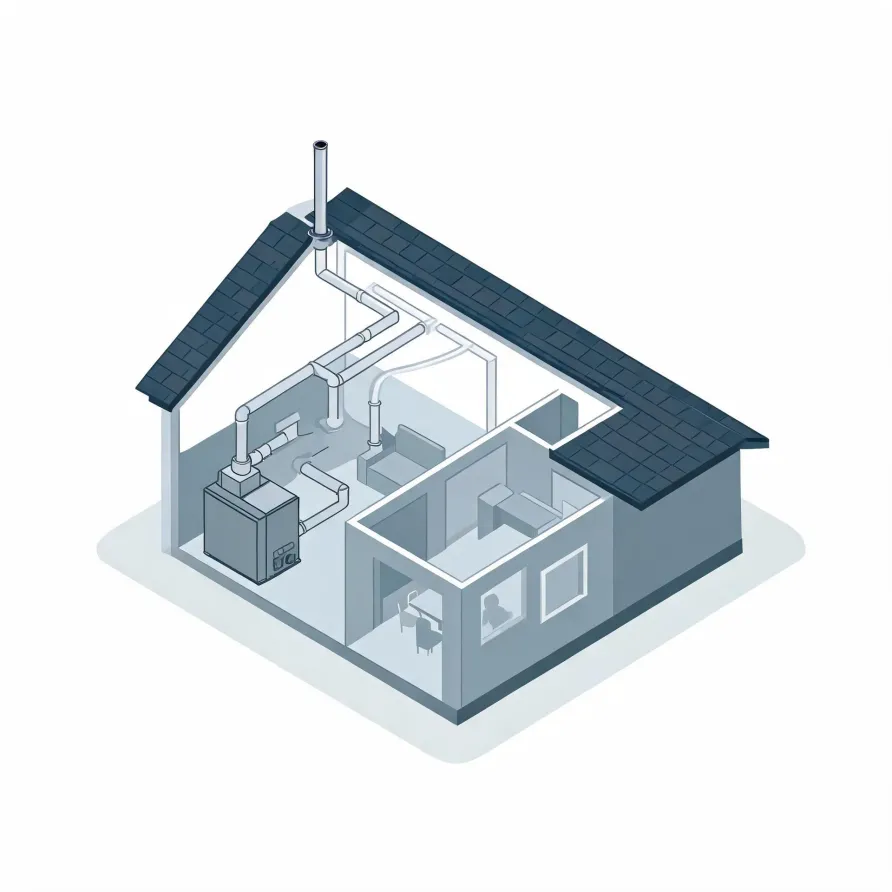
The furnace itself sits in a utility space, basement, or dedicated mechanical closet and is the unit a homeowner sees when they look at the heating system. It houses the heat exchanger, the burner assembly, and the blower, all of which live inside that cabinet. The blower pushes conditioned air into the supply side of the house once the burner has done its work.
The flue pipe runs from the furnace to an exterior wall or roof and carries combustion gases out of the house. The thermostat mounts on an interior wall and is the control point a homeowner touches. A new installation also brings a fresh air filter housing into position at the return-air intake, which is where unfiltered air enters the system before it reaches the furnace.
The drawing shows a typical layout, and a licensed contractor determines exactly what applies to this house based on its structure, existing connections, and local code requirements.
Get matched in Douglas CountyDouglas County, Nevada, by the numbers
513 severe weather events were recorded in Douglas County, Nevada between 2015 and 2024.
NOAA National Centers for Environmental Information, Storm Events Database, bulk CSV export, events 2015-01-01 through 2024-12-31.Half the homes in Douglas County, Nevada were built in 1990 or earlier (2020-2024 ACS 5-year).
U.S. Census Bureau, 2020-2024 American Community Survey 5-Year EstimatesDouglas County, Nevada holds 24,825 housing units (2020-2024 ACS 5-year).
U.S. Census Bureau, 2020-2024 American Community Survey 5-Year EstimatesOwners occupy 78.8% of the occupied homes in Douglas County, Nevada (2020-2024 ACS 5-year).
U.S. Census Bureau, 2020-2024 American Community Survey 5-Year EstimatesFurnace Installation Rules for Douglas County, Nevada5 codes, standards & laws
What the Installation Actually Looks Like
Non-weatherized gas furnaces manufactured on or after November 19, 2015 must reach 80.0 percent AFUE.
Non-weatherized oil-fired furnaces manufactured on or after November 19, 2015 must reach 83.0 percent AFUE.
Mobile home gas furnaces manufactured on or after November 19, 2015 must reach 80.0 percent AFUE.
Non-weatherized gas furnaces manufactured on or after December 18, 2028 must reach 95.0 percent AFUE, up from the 80.0 percent minimum that applies to units manufactured before that date.
Licensing Rules for HVAC Work in Douglas County, Nevada
In Nevada refrigeration and air-conditioning work is specialty contracting, and a general building contractor may not perform it without holding the licence for that specialty.
Severe Weather Events in Douglas County
Extreme weather puts real hours on heating equipment. A furnace that carries a home through hard winters in Douglas County works differently than one installed in mild ground, and that workload shapes what sizing and installation decisions are right here.
513 severe weather events, 2015–2024. Source: NOAA National Centers for Environmental Information, Storm Events Database.